

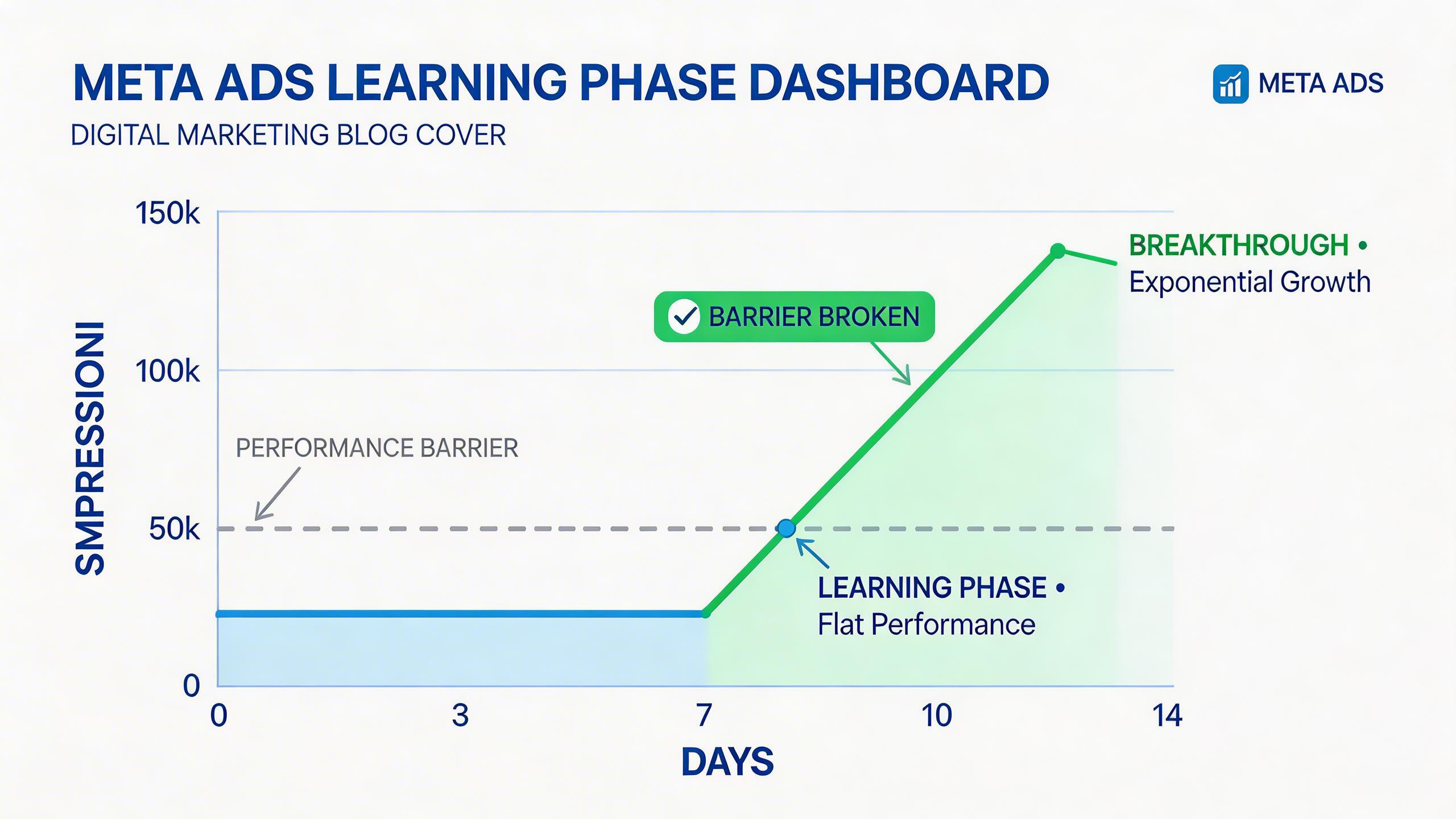
What Is the Meta Ads Learning Phase — and Why Should You Care?
Every time you launch a new ad set on Meta (Facebook and Instagram), the delivery system enters what’s called the learning phase. During this period, Meta’s algorithm is actively experimenting — testing different audience segments, placements, and times of day to figure out the most efficient way to deliver your ads and generate conversions.
Think of the learning phase as Meta’s calibration period. The algorithm needs data to learn who is most likely to convert, and until it gets enough of that data, your results will be volatile. CPAs swing wildly, delivery is inconsistent, and ROAS looks unpredictable. This is normal — but it’s also expensive if it drags on too long.
Here’s the key number you need to know: Meta requires approximately 50 conversion events per ad set per week to exit the learning phase. Once you hit that threshold, the ad set moves into the “Active” status, and performance stabilizes. If you don’t reach 50 conversions within roughly seven days, the ad set gets labeled “Learning Limited” — a signal that Meta can’t optimize delivery effectively.
In 2026, with rising CPMs across most verticals and increased competition in the Meta auction, getting stuck in the learning phase isn’t just an inconvenience — it’s a direct hit to your profitability. Every day you spend in learning is a day of inflated costs and missed revenue. The faster you exit, the sooner you can scale with confidence.
7 Proven Strategies to Exit the Learning Phase Faster
Exiting the learning phase quickly requires a deliberate approach. These seven strategies are battle-tested by performance marketing teams running six and seven-figure monthly budgets on Meta in 2026.
1. Consolidate Your Ad Sets
This is the single most impactful change you can make. Every separate ad set has its own learning phase. If you’re splitting your budget across 10 ad sets with $50/day each, none of them may reach the 50-conversion threshold. Instead, consolidate into 2-3 ad sets with larger budgets. This concentrates your conversion volume and dramatically accelerates learning.
Practical rule: if an ad set isn’t generating at least 50 conversions per week, it either needs more budget or needs to be merged with another ad set targeting a similar audience.
2. Broaden Your Targeting
Narrow audiences restrict Meta’s ability to find converters quickly. In 2026, Meta’s machine learning is sophisticated enough to find your ideal customers within broad audiences — often better than you can with manual interest targeting.
Start with broader geographic targeting, remove unnecessary exclusions, and let Meta’s algorithm do the heavy lifting. If you’re running ecommerce campaigns, consider using Advantage+ Audience with audience suggestions rather than hard-coded interest targets. Meta treats your targeting inputs as suggestions and expands beyond them when it finds conversion opportunities.
3. Optimize for Higher-Funnel Events (Temporarily)
If your purchase volume is too low to hit 50 events per week, consider temporarily optimizing for a higher-funnel conversion event — such as Add to Cart or Initiate Checkout. These events occur more frequently, giving the algorithm more data points to learn from.
Once the ad set exits learning and you’ve accumulated enough pixel data, you can shift the optimization event back to Purchase. This step-down approach is particularly effective for high-AOV products where purchase events are naturally less frequent.
4. Implement the Conversions API (CAPI) for Signal Quality
Meta’s optimization is only as good as the data it receives. With ongoing privacy changes — iOS restrictions, browser-level tracking prevention, and evolving consent frameworks — relying solely on the Meta Pixel means you’re sending incomplete conversion data.
The Conversions API (CAPI) sends conversion events directly from your server to Meta, bypassing browser-level restrictions. This provides a more complete and reliable data stream. Better signal quality means Meta can identify converting users faster, which directly accelerates learning phase exit.
In 2026, CAPI isn’t optional — it’s foundational. Advertisers with properly implemented CAPI consistently see 15-25% better match rates and faster optimization compared to pixel-only setups.
5. Increase Budget Strategically (Not Aggressively)
Higher budgets mean more impressions, which means more conversion opportunities. But there’s a catch: increasing budget by more than 20% at once resets the learning phase. Meta treats large budget jumps as a significant change to the ad set, triggering a fresh round of learning.
The solution is the 20% budget increment rule, which we’ll detail in the next section. For now, know that strategic, gradual budget increases are one of the most reliable ways to feed the algorithm the data it needs without disrupting its progress.
6. Leverage Advantage+ Shopping Campaigns
Advantage+ Shopping Campaigns (ASC) are Meta’s AI-driven campaign type that automates audience targeting, placements, and creative optimization. Because ASC consolidates all audiences into a single campaign structure, it naturally concentrates conversion volume — making it easier to exit learning quickly.
ASC campaigns also benefit from Meta’s most advanced machine learning models, which can identify high-intent users across Meta’s entire family of apps. For ecommerce advertisers in 2026, ASC is often the fastest path out of the learning phase, especially when combined with a diverse creative set (we recommend 8-15 creative variations).
7. Improve Creative Quality and Volume
Higher click-through rates and conversion rates from better creatives mean more conversions from the same budget — which means faster learning. But creative quality goes beyond just making “better ads.” It means:
- Testing multiple formats — static images, video, carousel, and collection ads
- Diversifying hooks — different opening lines, value propositions, and angles
- Matching creative to funnel stage — awareness-level messaging for prospecting, product-specific messaging for retargeting
- Refreshing regularly — creative fatigue accelerates in 2026’s crowded feeds; plan for weekly or bi-weekly creative refreshes
More creative variations also give Meta’s algorithm more options to test, which can accelerate the learning process by finding winning combinations faster.
The 20% Budget Scaling Rule: A Step-by-Step Playbook
Once your ad set exits the learning phase and you’re seeing stable, profitable results, it’s time to scale. But scaling Meta ads without re-entering learning phase requires discipline. Here’s the exact process:
Step 1: Confirm You’ve Exited Learning
Check your ad set status in Ads Manager. It should show “Active” — not “Learning” or “Learning Limited.” Also verify that your CPA and ROAS have been stable for at least 3-4 days. Premature scaling of an ad set that appears stable but hasn’t fully optimized will likely trigger re-learning.
Step 2: Increase Budget by No More Than 20%
If your current daily budget is $100, increase it to $120. If it’s $500, go to $600. This 20% ceiling is Meta’s unofficial threshold — changes below this amount typically don’t reset the learning phase. Changes above it frequently do.

Step 3: Wait 3-4 Days Before the Next Increase
After each budget increase, give the algorithm 3-4 full days to adjust. Monitor your CPA and ROAS daily during this period. If performance remains stable (within 10-15% of your pre-increase benchmarks), you’re clear to make another 20% increase.
Step 4: Repeat the Cycle
Continue the pattern: 20% increase → wait 3-4 days → evaluate → increase again. Here’s what this looks like in practice:
- Day 1: $100/day budget → increase to $120
- Day 4-5: Performance stable → increase to $144
- Day 8-9: Performance stable → increase to $173
- Day 12-13: Performance stable → increase to $207
- Day 16-17: Performance stable → increase to $249
Within three weeks, you’ve more than doubled your budget while maintaining performance. That’s the power of disciplined, incremental scaling.
Step 5: Know When to Pause
If CPA rises more than 20% after a budget increase, pause the scaling. Revert to the previous budget and investigate. Common culprits include audience saturation, creative fatigue, or seasonal demand shifts. Fix the underlying issue before resuming the scaling ladder.
Post-Click Optimization: The Hidden Lever Most Advertisers Ignore
Here’s a truth that most Meta advertisers overlook: the learning phase isn’t just about getting clicks — it’s about generating conversions. And conversions happen after the click, on your landing page and through your checkout flow.
If your post-click experience is leaking conversions — slow load times, confusing landing pages, broken mobile experiences, or friction-filled checkout flows — you’re artificially suppressing your conversion rate. This means fewer conversion events flowing back to Meta, which means a longer learning phase and higher costs.
Improving your post-click conversion rate by even 10-20% can be the difference between hitting Meta’s 50-conversion threshold in 5 days versus 10 days. It’s also the difference between profitable scaling and burning through budget.
Key post-click optimization areas in 2026:
- Page load speed: Every additional second of load time reduces conversions by 7-10%. Aim for under 2.5 seconds on mobile.
- Landing page relevance: The message on your landing page must match the ad that brought the user there. Mismatches kill CVR.
- Mobile-first design: Over 80% of Meta traffic is mobile. If your landing page isn’t optimized for mobile, you’re losing the majority of your potential conversions.
- Re-engagement flows: Users who click but don’t convert immediately are not lost. Automated re-engagement — through email sequences, push notifications, or retargeting — recovers a significant percentage of these drop-offs.
- Link and redirect optimization: Broken links, slow redirects, and tracking parameter issues silently destroy conversions. Audit your post-click link chain regularly.
Post-click optimization is the highest-leverage activity for Meta advertisers in 2026 because it simultaneously improves your learning phase velocity, reduces your CPA, and increases your ROAS — all without spending an additional dollar on media.
Common Mistakes That Reset the Learning Phase
Even experienced advertisers accidentally reset their learning phase. Here are the most common triggers to avoid:
- Editing ad creative within an active ad set: Changing the image, video, headline, or primary text of an ad resets learning for that ad set. If you want to test new creative, create a new ad within the ad set rather than editing an existing one.
- Changing the optimization event: Switching from “Purchase” to “Add to Cart” (or vice versa) is a significant change that triggers a full learning reset.
- Adjusting targeting significantly: Adding or removing large audience segments, changing age ranges substantially, or switching between custom audiences resets learning.
- Budget changes exceeding 20%: As discussed, keep budget adjustments within the 20% rule to avoid re-entering learning.
- Pausing and restarting ad sets: Pausing an ad set for more than a brief period (a few hours) and then restarting it often triggers a partial or full learning reset.
- Changing bid strategy: Moving from “Lowest Cost” to “Cost Cap” or “Bid Cap” is a fundamental change to how Meta bids in the auction, triggering a new learning phase.
The general principle: any change that significantly alters how Meta delivers your ads or measures success will reset the learning phase. When in doubt, make changes in a new ad set rather than modifying an existing one.
Your Action Checklist: Exit Learning Phase and Scale in 2026
Here’s a practical checklist you can implement starting today:
- Audit your account structure. Count your active ad sets. If you have more than 3-5 per campaign, consolidate. Fewer ad sets with larger budgets exit learning faster.
- Check your CAPI implementation. Go to Events Manager → Diagnostics. Ensure your match quality score is 7.0 or above. If it’s lower, work with your developer to send additional customer parameters (email, phone, IP address).
- Review your conversion event. Is your optimization event generating at least 50 events per ad set per week? If not, consider temporarily moving to a higher-funnel event.
- Broaden your targeting. Remove unnecessary interest exclusions and audience restrictions. Let Meta’s algorithm find your converters within broader audiences.
- Test Advantage+ campaigns. If you’re running ecommerce, launch an ASC campaign alongside your manual campaigns. Compare learning phase exit speed and stable-state performance.
- Implement the 20% scaling rule. Once ad sets exit learning, scale budgets in 20% increments every 3-4 days. Track CPA and ROAS at each step.
- Audit your post-click experience. Run your landing pages through Google PageSpeed Insights. Check mobile load times, form functionality, and checkout flow. Fix any friction points that suppress conversion rates.
- Set up post-click re-engagement. Implement automated flows to recover users who click but don’t convert. This directly increases the conversion volume that Meta uses to optimize delivery.
- Refresh creative every 1-2 weeks. Maintain a pipeline of 8-15 creative variations per ad set. Replace underperformers with fresh assets before fatigue sets in.
- Monitor ad set status daily. Set up a daily check of ad set delivery status. If any ad set drops to “Learning Limited,” diagnose and fix the issue immediately — don’t let it persist.
The Bottom Line
Exiting the Meta Ads learning phase quickly is not about hacks or shortcuts — it’s about giving the algorithm exactly what it needs: sufficient conversion volume, clean data signals, and a stable campaign structure. In 2026, the advertisers who win on Meta are those who combine disciplined account management with strong post-click optimization to maximize the value of every dollar spent.
The 50-conversion threshold, the 20% scaling rule, and the 3-4 day stabilization periods aren’t arbitrary — they’re the operating parameters of Meta’s machine learning system. Work with them, not against them, and you’ll build campaigns that scale profitably over months and years.
Stop losing conversions after the click.
DeepClick helps Meta advertisers fix post-click drop-offs and improve CVR by 30%+ through automated re-engagement and post-click link optimization.
发表回复