

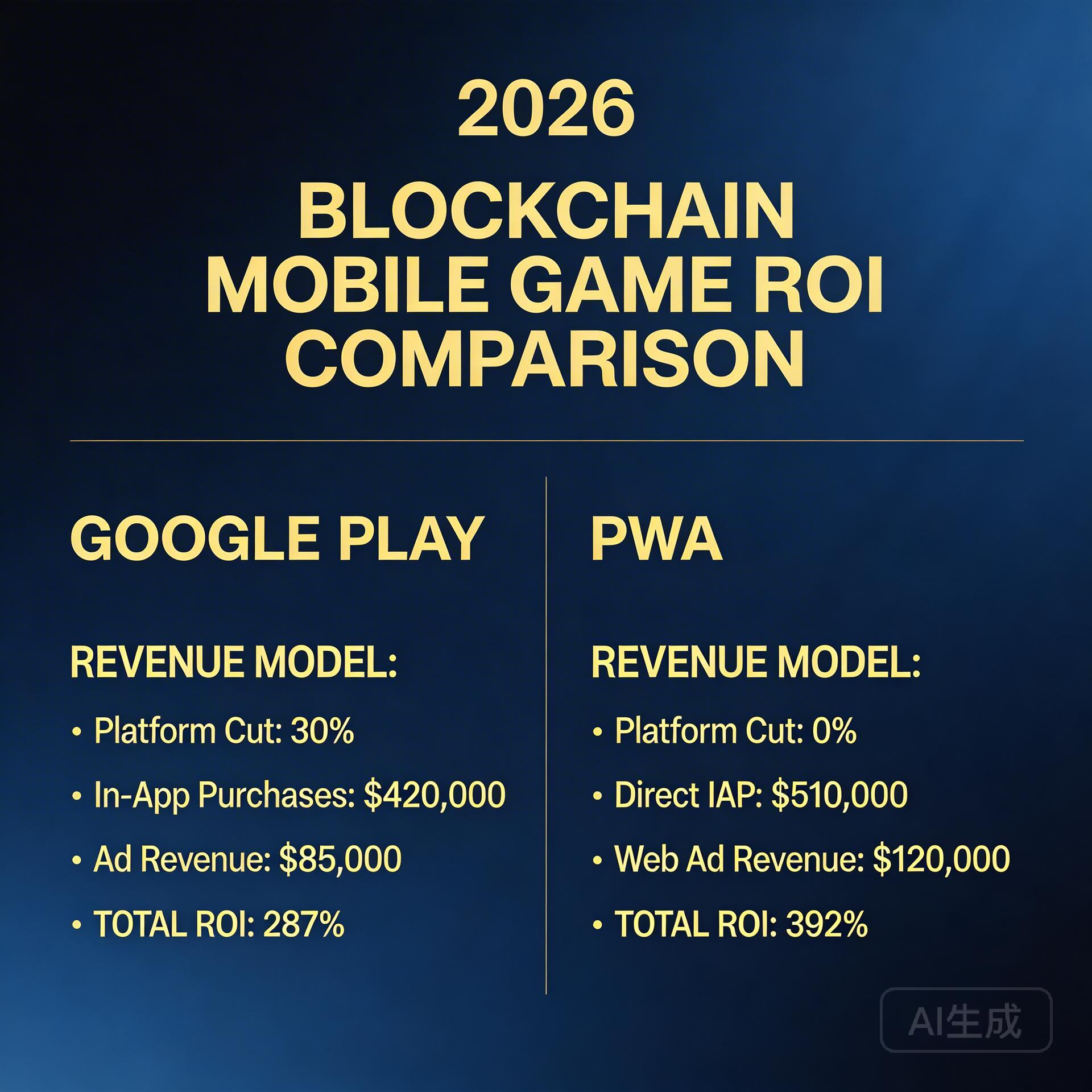
BC (blockchain) and casual mobile games face a unique distribution dilemma in 2026: Google Play’s 30% revenue cut hits particularly hard for games with in-app purchase models, while UAC (Universal App Campaigns) remain the dominant paid channel for driving installs at scale. But a growing number of BC game teams are running a hybrid model — using UAC to drive traffic and PWA to distribute the game itself, bypassing the Play Store entirely.
The ROI case for this shift is compelling on paper. Whether it holds up in real campaign data is another question. This article breaks down the actual numbers: UAC vs PWA distribution ROI for BC game teams in 2026, where the economics work, and where they don’t.
→ Want to bypass Google Play entirely? See how ROiBest PWA works — no submission, no cut, 1.2x installs.
The Revenue Math: Why BC Games Feel the Play Store Cut Most
Google Play’s 30% commission on in-app purchases is a known cost — but for BC games with high average revenue per user (ARPU), it compounds significantly. Consider a BC game with $40 average monthly ARPU:
- Via Google Play: $40 × 70% = $28 net revenue per monthly active user
- Via PWA: $40 × 100% = $40 net revenue per monthly active user (direct payment processor fees: 2–3%)
That $12 difference per MAU isn’t just profit margin — it directly changes how much you can afford to spend per install on UAC. At $28 net ARPU, a breakeven CPI target might be $8. At $40 net ARPU, that ceiling rises to $11.40 — a 42% increase in how aggressively you can bid in auctions.
This is the core ROI argument for BC game PWA distribution: it’s not just about saving money, it’s about expanding your competitive bidding capacity in Google Ads auctions.
UAC Performance in BC Game Campaigns: What to Expect

UAC remains the most efficient way to drive volume for BC games via Google’s ecosystem. Key benchmarks for 2026:
- Average CPI (casual BC game, UAC): $2.50–$6.00 depending on geo and targeting
- D7 retention (BC games via UAC): 18–28% (lower than casual gaming due to onboarding complexity)
- ROAS breakeven (typical BC model): 90–180 days post-install
The challenge: UAC optimization in Google Ads requires either Play Store distribution (for native apps) or a strong in-app event signal chain (for web/PWA). If you’re distributing via PWA, your conversion tracking setup becomes the make-or-break factor for UAC performance.
UAC + PWA tracking requirements
For UAC to optimize effectively toward PWA installs:
- GA4 event tracking must fire on the PWA install action (beforeinstallprompt acceptance)
- That GA4 event must be imported as a Google Ads conversion
- In-app events (registration, first deposit, first purchase) must be tracked via GA4 + Measurement Protocol for web-based games
- Minimum 30–50 conversion events per week before UAC can exit learning mode
Teams that skip step 3 typically see UAC optimize toward installs only, ignoring downstream revenue events — leading to high install volume but poor ROAS.
PWA Distribution ROI: Three Scenarios
The ROI of PWA distribution for BC games isn’t binary — it depends heavily on your existing player base, payment model, and geo mix. Three common scenarios:
Scenario A: New BC game, no existing player base
PWA is a strong choice if your game is entering a market where Google Play approval is uncertain (common for BC games with token mechanics) or where the 30% cut materially changes your unit economics. The tradeoff: no Play Store discovery — 100% of installs must come from paid or organic web traffic. ROI depends on your ability to drive PWA traffic efficiently via Google Ads or Meta.
Verdict: High ROI potential, higher operational complexity. Budget at least 3 months of learning period for UAC + PWA tracking to stabilize.
Scenario B: Existing Play Store game, adding PWA channel
Running PWA as a parallel distribution channel lets you capture the revenue margin benefit without abandoning Play Store discovery. New users acquired via Google Ads can be routed to PWA; organic Play Store users continue through the native path. This hybrid approach typically improves blended ROAS by 15–25% without operational disruption.
Verdict: Lowest risk, fastest ROI. Most BC game teams with existing Play Store presence start here.
Scenario C: BC game facing Play Store rejection or removal
For games with token mechanics or real-money reward systems that trigger Play Store policy violations, PWA is an immediate alternative distribution channel rather than an optimization play. The ROI question here is less about margin and more about revenue continuity. Teams that pre-build PWA infrastructure before Play Store issues arise recover 3–5x faster than those building it under pressure.
Verdict: Existential ROI — PWA preserves revenue flow that would otherwise go to zero.
For a detailed comparison of Google Ads PWA campaigns vs native app installs, see our guide on PWA vs native app conversion rate in Google Ads 2026.
Re-Engagement: Where PWA Outperforms Play Store at Scale
For BC games with high D30 churn (which is typical), the re-engagement layer is where PWA’s structural advantage becomes most tangible. PWA push notifications work even after a user uninstalls — something native apps cannot do. For a game with 40% D30 churn, that’s a large pool of high-intent users you can reach without paying acquisition costs again.
BC game PWA re-engagement benchmarks:
- Push open rate (dormant user win-back): 8–15%
- Re-engaged user LTV vs cold acquisition: 1.6–2.0x
- Cost to re-engage via push vs paid re-acquisition: 90–95% lower
For a deeper look at building Google Ads re-engagement campaigns around PWA push, see our article on PWA push notification Google Ads re-engagement strategy 2026.
The complete Google Ads + PWA install campaign framework is covered in our Google Ads PWA install campaign guide.
Decision Framework: When Does PWA Beat UAC-Only?
| Factor | Favors UAC + Play Store | Favors UAC + PWA |
|---|---|---|
| Monthly ARPU | Under $15 | Over $25 |
| Play Store approval risk | Low | Medium–High |
| D30 churn rate | Under 30% | Over 40% |
| Payment model | Ad-based revenue | In-app purchases / subscriptions |
| Geo focus | Tier 1 (high Play Store penetration) | Emerging markets (lower Play compliance) |
Action Checklist: BC Game UAC + PWA ROI 2026
- ☐ Calculate your net ARPU under Play Store cut vs PWA direct — this sets your bidding ceiling
- ☐ Set up GA4 PWA install event tracking before running UAC
- ☐ Import in-app events (registration, first purchase) into Google Ads as secondary conversions
- ☐ Reach 50+ conversion events/week before scaling UAC budget
- ☐ Enable PWA push notifications at install for re-engagement capability
- ☐ If adding PWA alongside Play Store: route paid traffic to PWA, organic to Play Store
- ☐ Build PWA infrastructure before you need it (don’t build under emergency)
- ☐ Track blended ROAS (Play Store + PWA) vs UAC-only to measure true ROI shift
Skip the app store. Go live instantly, keep 100% of your revenue.
ROiBest helps Android app teams launch PWAs — no review process, no 30% Google Play cut, and push notifications that work even after uninstall. Teams see up to 1.2x higher install conversion rates vs native app downloads.
发表回复