

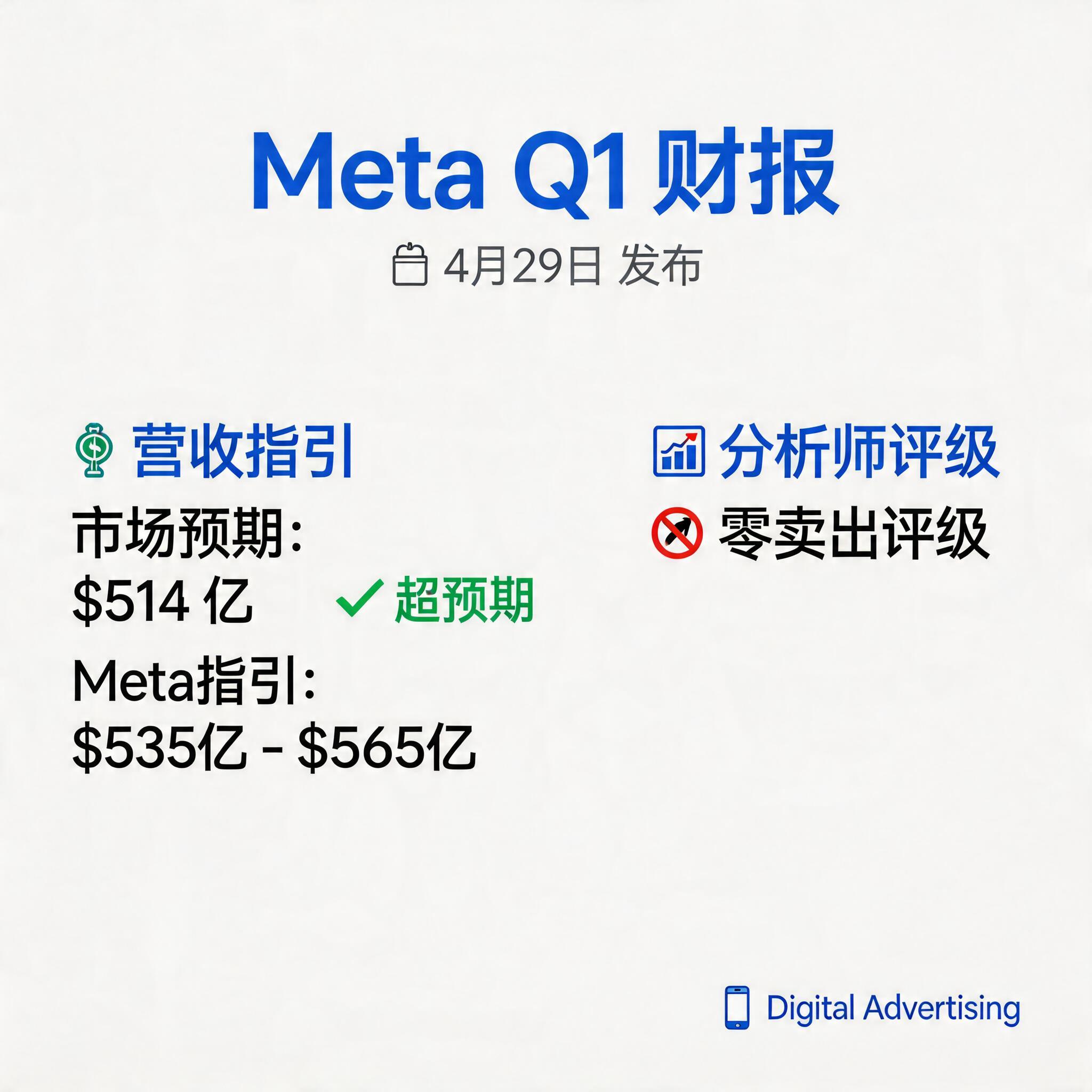
Meta Platforms is set to release its Q1 2025 earnings on April 29, and Wall Street is already buzzing. The company guided revenue between $53.5 billion and $56.5 billion — well above the $51.4 billion consensus estimate. Yet a massive $135 billion AI capital expenditure plan sent shares down 1.71% to $676. With zero sell ratings among analysts and an average price target of $847 (representing 25%+ upside), this earnings report could reshape how advertisers think about Meta’s ad ecosystem and where they allocate budget.
→ See how ROiBest PWA works — no submission, no cut, 1.2x installs.
Meta Q1 Revenue Guidance Crushes Expectations
Meta’s $53.5–$56.5 billion revenue guidance for Q1 2025 represents 14–20% year-over-year growth — a significant beat over the $51.4 billion analyst consensus. This acceleration is driven by three key factors:
- Advantage+ AI ad tools: Meta reported that advertisers using Advantage+ shopping campaigns saw an average 32% improvement in return on ad spend (ROAS) in late 2024.
- Reels monetization: Short-form video ad revenue grew 40%+ year-over-year, narrowing the gap with feed placements.
- Click-to-message ads: Business messaging ads now contribute over $10 billion in annual run rate, particularly strong in emerging markets.
For app marketers running conversion-value-optimized campaigns, Meta’s stronger-than-expected ad revenue signals intensifying competition for inventory. Cost-per-install (CPI) on Meta rose 18% in Q4 2024 alone. Diversifying install channels — including PWA distribution — helps offset rising auction costs.
Why $135 Billion AI Spending Spooked Investors

Meta raised its 2025 capital expenditure forecast to $60–$65 billion (up from $38 billion in 2024), with a cumulative $135 billion AI infrastructure commitment through 2026. The market reacted with a 1.71% share decline, pushing the stock to $676. Here is what the spending covers:
- Custom silicon: Meta’s MTIA chip program aims to reduce reliance on NVIDIA GPUs by 2026, cutting inference costs by an estimated 40%.
- Llama model training: Llama 4 training clusters require 100,000+ GPU equivalents, driving near-term capex spikes.
- AI-powered ad delivery: Internal models now handle 70% of ad ranking decisions, improving conversion prediction accuracy by 22% according to Meta’s Q4 2024 earnings call.
The investment thesis is straightforward: better AI models produce better ad targeting, which produces higher advertiser ROAS, which produces higher ad prices Meta can charge. Analysts see this cycle sustaining 15%+ revenue growth through 2026.
Analyst Consensus: Zero Sell Ratings, $847 Target
Among 60+ analysts covering Meta, there are currently zero sell ratings — a rare show of unanimous bullishness for a $1.7 trillion company. The average 12-month price target of $847 implies roughly 25% upside from the current $676 level. Key bull arguments include:
- Operating margin expansion: Despite massive AI capex, Meta maintained 41% operating margins in Q4 2024 and guided for 39–42% in Q1 2025.
- WhatsApp monetization: Business API revenue grew 80%+ year-over-year with minimal cannibalization of core ad products.
- Reality Labs losses narrowing: The division lost $4.6 billion in Q4 2024, down from $5.7 billion in Q3 — the first sequential improvement in two years.
For performance marketers, this analyst confidence matters because it signals Meta will continue investing heavily in ad tools. If you are running app install campaigns on Meta and facing rising CPIs, consider splitting budget toward alternative PWA distribution channels that bypass app store fees entirely.
3 Actionable Steps for Advertisers Before Q1 Earnings
Step 1: Audit your Meta CPI trends now. Pull your last 90 days of cost-per-install data from Meta Ads Manager. If CPI rose more than 15%, you are likely being outbid by Advantage+ adopters. Shift 10–20% of budget to test PWA install campaigns where there is no app store commission eating into your unit economics.
Step 2: Implement enhanced conversion tracking. Meta’s Conversions API (CAPI) now handles server-side event matching with 95%+ accuracy. Pairing this with enhanced conversion setups across Google gives you a unified view of true acquisition cost across platforms.
Step 3: Diversify install channels before Q2 CPM spikes. Historically, Meta CPMs rise 8–12% in Q2 as e-commerce brands increase spend. Lock in lower acquisition costs now by testing PWA direct-install flows that eliminate the 15–30% app store tax. Advertisers using optimized PMax landing pages report 1.2x higher install rates compared to standard Play Store redirects.
What to Watch on April 29
Three numbers will determine Meta’s post-earnings trajectory: (1) actual Q1 revenue versus the $53.5–$56.5 billion guidance range, (2) Q2 revenue guidance relative to the current $54.8 billion consensus, and (3) any updates to the $60–$65 billion capex forecast. A beat on revenue with maintained capex guidance would likely push the stock toward the $847 consensus target. For advertisers, stronger-than-expected results mean continued ad price inflation — making alternative distribution strategies not just smart, but essential for protecting margins in the second half of 2025.
Skip the app store. Keep 100% revenue.
发表评论