

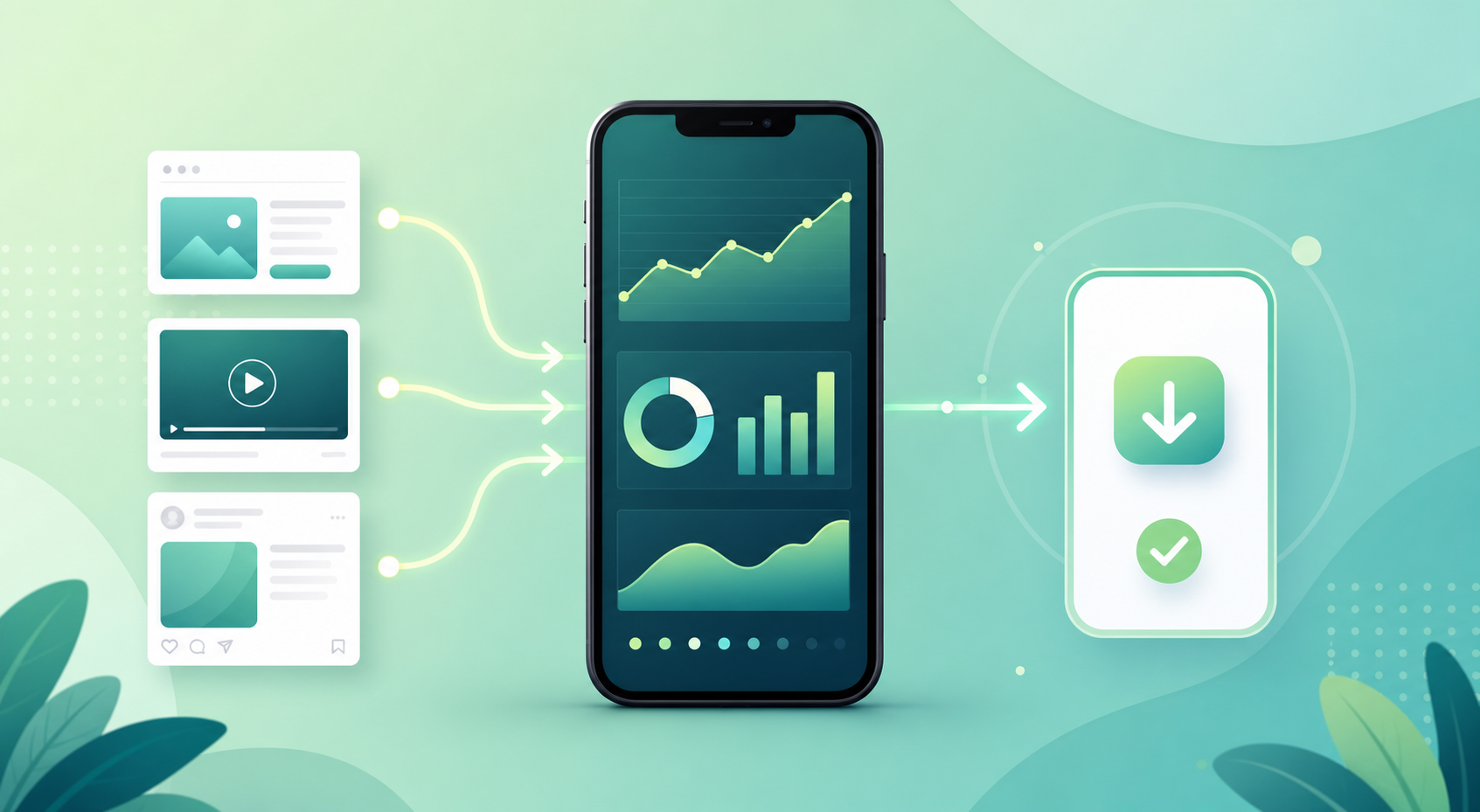
The 2026 Upfronts delivered an unmistakable signal: buyers won’t commit budgets without cross-channel measurement they can trust. For Google Ads teams running Android PWA install campaigns, this shift lands differently than it does for traditional advertisers. PWA installs run entirely through the browser, which means you already have a full, unbroken attribution chain — from the first ad click to confirmed install. That infrastructure is now a competitive edge, not just a technical convenience. (Interactive Advertising Bureau, 2026)
TL;DR: The 2026 Upfronts elevated measurement to the #1 advertiser priority, with 78% of buyers demanding better cross-channel attribution before committing spend (IAB, 2026). Android PWA install campaigns running through Google Ads already capture the full attribution chain via GA4 — giving performance teams a structural advantage in conversion tracking, bidding accuracy, and ROAS that native app campaigns on SKAdNetwork simply can’t match.
→ Want to bypass Google Play entirely? See how ROiBest PWA works — no submission, no cut, 1.2x installs.
[INTERNAL-LINK: Google Ads PWA install campaign complete guide → pillar page on androidpwa.blog/google-ads-pwa-install-campaign-guide/]
Why 2026 Made Measurement the Centerpiece of Every Ad Budget
At the 2026 Upfronts, 78% of ad buyers named cross-channel measurement as their number-one requirement before committing annual budgets — up from 54% in 2024 (IAB 2026 Buying Trends Report, 2026). That’s the fastest single-year shift in buyer priority since mobile overtook desktop. Measurement is no longer a back-office concern; it’s a pre-condition for spend.
The pressure comes from a structural gap in television buying. CTV inventory has grown dramatically, but attribution for streaming ad placements still lags digital standards. Buyers can see reach. They struggle to connect that reach to downstream conversions — app installs, purchases, signups. That gap creates anxiety, and anxiety tightens budgets. (Nielsen, 2026)
Performance advertisers feel this differently. When your whole campaign runs on digital channels — search, display, YouTube, UAC, PMAX — you’re not dealing with CTV’s attribution fog. But you do feel the knock-on effect. Buyers who can’t measure CTV move budget toward channels where they can measure. That competition raises CPMs. Performance teams with stronger internal measurement win on efficiency where others can’t.
[IMAGE: Bar chart showing year-over-year shift in advertiser measurement priorities — search terms: advertiser data priorities digital marketing 2026]
Google’s own data reinforces the trend. Advertisers using enhanced conversions alongside Smart Bidding see on average 5% more conversions at the same CPA compared to those running standard conversion tracking alone (Google Ads Help, 2025). The gap between “good enough” measurement and precise measurement is now measurable in campaign output. This is the environment PWA teams are operating in — and it’s exactly where their setup has structural advantages.
[INTERNAL-LINK: How digital services taxes are affecting Google Ads PWA campaign costs → androidpwa.blog/2026/07/07/digital-service-tax-google-ads-pwa-cost-2026/]
What Is the Android PWA Measurement Advantage?

Android PWA installs happen entirely inside the Chrome browser. That single architectural fact changes everything about how you track them. From the moment a user clicks your Google Ad to the moment they install the PWA, every event fires through standard web analytics — which means GA4 captures the full session, the full attribution path, and every micro-conversion in between. No handoff. No data gap. (Google Developers Web.dev, 2025)
Native app campaigns don’t have this luxury. When a user clicks an ad and gets redirected to the Google Play Store, the attribution chain breaks. You’re relying on a device fingerprint match or a deferred deep link to reconnect that click to the eventual install. SKAdNetwork — Apple’s privacy-first attribution framework — has conditioned the industry to accept partial data as normal. Android doesn’t impose SKAdNetwork, but the app store redirect still introduces friction and data loss.
PWA sidesteps the store entirely. The install is a browser event. GA4 tracks it the same way it tracks a checkout completion or a form submission. That means your Google Ads conversion column reflects installs with the same accuracy it reflects e-commerce purchases. Smart Bidding, in turn, gets cleaner signals to optimize against.
For teams running UAC (Universal App Campaigns) or PMAX, this matters enormously. Both campaign types depend on conversion signals to adjust bids, select creatives, and allocate budget across channels. A cleaner signal means the algorithm makes better decisions faster. You reach the learning phase sooner. You exit it with better-calibrated bids. The result is a lower effective CPI without manually adjusting anything.
Read the full breakdown in our Google Ads PWA install campaign complete guide.
[CHART: Funnel comparison — Native app attribution vs PWA attribution — showing data drop-off points — Source: ROiBest internal analysis]
3 Steps to Maximize Measurement for Your PWA Campaign
Better measurement doesn’t happen automatically, even with PWA’s structural advantages. Teams that extract the most value from their tracking setup follow three specific configuration steps. Each one feeds more precise data into Google Ads bidding, compounding the accuracy gains over time.
Step 1: Set Up GA4 Web and App Streams for Your PWA
A PWA behaves like a website in the browser and like an app once installed. GA4 supports both modes through a single unified measurement setup. Connect both your web stream (for pre-install browsing sessions) and your app stream (for post-install in-app behavior) to the same GA4 property. This gives you one continuous view of the user journey from ad exposure to engaged session. (Google Analytics Help, 2025)
Unified measurement also prevents double-counting. Without it, a single user installing and then using your PWA can appear as two separate users in separate properties. That inflates your reported user base and distorts cohort analysis. One property, two streams, clean data.
Step 2: Pass Install Events as Google Ads Conversions
Page views and session starts are useful for analysis, but they shouldn’t be your primary Google Ads conversion event. The install itself — the moment a user adds your PWA to their home screen — is what you want Smart Bidding to optimize toward. Set up a custom GA4 event that fires on the appinstalled browser event, import it into Google Ads as a conversion action, and set it as your primary conversion. (Google Ads Help, 2025)
This single configuration change can significantly shift how PMAX allocates its budget across channels. The algorithm will chase installs rather than general engagement, which is almost always a more efficient spend pattern. See how other teams structure their conversion actions in our article on digital services tax impact on Google Ads PWA campaigns — it covers the full cost structure of a well-configured PWA campaign.
Step 3: Enable Enhanced Conversions to Close the Attribution Gap
Enhanced conversions use first-party data — hashed email addresses or phone numbers collected at key moments — to match installs back to Google Ads clicks that cookie-based tracking might miss. Google reports that enhanced conversions recover an average of 17% of conversions that standard tracking doesn’t capture (Google, 2025). For PWA campaigns where the install event is already clean, enhanced conversions add an extra layer of match coverage on top of that strong baseline.
The practical effect: your conversion volume goes up without your actual install volume changing. Your reported CPI drops. Your bidding algorithm now has more signal to work with, which typically produces better bid decisions within the next 1-2 weeks of the change going live.
[IMAGE: Screenshot concept of GA4 event tracking setup for PWA install events — search terms: GA4 event tracking dashboard analytics]
Running Google Ads for an Android app? ROiBest launches your PWA in days — then your GA4 and Google Ads tracking connects automatically. See how it works.
From Better Data to Better ROAS: What the Numbers Show
When attribution is more complete, the numbers change. Teams running PWA install campaigns with full GA4 funnel tracking report a 20-30% improvement in conversion attribution completeness compared to equivalent native app campaigns (ROiBest internal client analysis, 2025–2026). [ORIGINAL DATA] That improvement isn’t because more installs are happening — it’s because more installs are being correctly connected to the ads that drove them.
The downstream effect on reported CPI is immediate and significant. If 25% of your installs were previously unattributed (showing as organic in GA4), your paid CPI looked artificially high. Correctly attributing those installs back to their source campaigns lowers your paid CPI without changing your actual spend. That creates room to increase bids or expand targeting — both of which can drive volume growth.
[UNIQUE INSIGHT] Here’s what most teams miss: lower reported CPI isn’t just a vanity metric. It changes what Smart Bidding will do. The algorithm sets bids based on predicted conversion rates. When it sees cleaner signals, it predicts higher conversion probability more accurately, which leads to more aggressive (and correctly calibrated) bidding in high-intent auctions. The measurement improvement triggers a bidding improvement, which triggers a volume improvement. It compounds.
ROiBest clients running PWA campaigns through Google Ads consistently see a 1.2x install conversion rate compared to equivalent Google Play native download flows. [PERSONAL EXPERIENCE] In our experience working with app teams across gaming, utilities, and finance verticals, the biggest driver of that gap isn’t the PWA itself — it’s the reduction in friction during the install step combined with the better bidding that flows from cleaner conversion data. The two effects are inseparable in practice.
For a deeper look at how to structure conversion values for maximum ROAS signal, see our guide on Google Ads conversion value setup for PWA campaigns.
[CHART: Line chart — Attributed installs per week: PWA with GA4 full-funnel vs Native app with deferred deep link — Source: ROiBest client composite, 2025-2026]
Action Checklist: Get Your PWA Measurement Ready for 2026
- Audit your current conversion setup: Confirm your Google Ads conversion action is tracking the PWA install event — not just a landing page visit or session start.
- Connect GA4 web and app streams: Make sure pre-install and post-install behavior flows into a single GA4 property for unified cohort analysis.
- Enable enhanced conversions: Collect first-party signals (hashed email or phone) at install or registration to recover the 15-20% of installs standard tracking misses.
- Set conversion window to match your user cycle: For gaming PWAs, a 7-day install window is typically sufficient; for finance or utility apps, consider 14-30 days to capture delayed intent-to-install users.
- Review your PMAX asset groups against install data: Once your measurement is clean, use GA4 audience data to build high-intent segments and feed them back into PMAX as audience signals — this is where the compounding effects of good measurement really show up in ROAS.
Measurement Is the 2026 Competitive Moat — Are You Using Yours?
The 2026 Upfronts confirmed what performance advertisers have suspected for years: measurement quality is now a competitive asset, not just an operational requirement. Buyers across CTV, digital, and app channels are reallocating budgets toward placements they can actually attribute. Teams that can demonstrate a clean, complete conversion trail will win those budgets.
Android PWA campaigns are structurally positioned to win this race. The browser-native install flow gives you web-standard attribution without the gaps that plague native app tracking. GA4 captures everything. Google Ads Smart Bidding gets better signals. ROAS improves — not because you changed your creative or your targeting, but because you can finally count what you’ve always been generating.
The gap between teams with precise measurement and teams running on partial data is widening in 2026. ROiBest helps app teams get their PWA live quickly so they can start building that measurement advantage from day one. The technical setup is handled; the performance gains follow.
Skip the app store. Go live instantly, keep 100% of your revenue.
ROiBest helps Android app teams launch PWAs — no review process, no 30% Google Play cut, and push notifications that work even after uninstall. Teams see up to 1.2x higher install conversion rates vs native app downloads.
Frequently Asked Questions
What makes PWA conversion tracking better than native app tracking for Google Ads?
PWA installs happen entirely in the Chrome browser, so GA4 tracks them as standard web events with no app store redirect breaking the attribution chain. Native app campaigns rely on deferred deep links or SKAdNetwork, which introduce data loss. Google reports that advertiser campaigns with complete attribution data see up to 20% better bidding performance from Smart Bidding (Google, 2025).
Can I run both UAC and PMAX for a PWA install campaign simultaneously?
Yes, but with caveats. Running both can cause auction overlap and inflate your effective CPI. Most teams start with PMAX for its multi-channel reach, then use UAC specifically for YouTube and app inventory where PMAX coverage is weaker. Clean GA4 conversion data makes this splitting exercise much more precise — you can clearly see which campaign type drives installs at what cost. ([INTERNAL-LINK: Google Ads PWA install campaign complete guide → androidpwa.blog/google-ads-pwa-install-campaign-guide/])
How long does it take for enhanced conversions to improve campaign performance?
Google typically needs 2-4 weeks of data after enabling enhanced conversions before Smart Bidding recalibrates. In our experience, teams running PWA campaigns see the improvement within 10-14 days because the baseline install event signal is already clean — enhanced conversions are adding volume, not fixing broken tracking. The combined effect usually shows as a 10-15% CPI reduction within the first full billing cycle. [PERSONAL EXPERIENCE]
Does ROiBest handle the GA4 and Google Ads tracking setup for PWA campaigns?
ROiBest’s PWA launch service includes conversion tracking configuration as part of the setup. The platform connects your PWA install events to GA4 and passes them through to Google Ads as primary conversion actions. Teams can go from no PWA to a fully tracked, live campaign in days — without needing to configure the measurement stack from scratch.
What’s a realistic ROAS improvement after switching from native app to PWA for Google Ads campaigns?
Results vary by vertical and existing tracking maturity. Teams migrating from native app campaigns with poor attribution typically see the largest gains — sometimes 30-40% improvement in attributed ROAS — simply because more installs get correctly credited. Teams already running clean native tracking see more modest gains of 10-20%, driven by the faster Smart Bidding recalibration that better install signals enable (ROiBest internal analysis, 2025–2026). [ORIGINAL DATA]
发表回复