
If your Google Ads campaigns are driving users to the Google Play Store to install your app, you’re paying a premium for every conversion — and losing buyers at every redirect. The install funnel has too many exits: slow store pages, users who don’t have Google Play installed, friction from a multi-step process that kills impulse decisions.
PWA (Progressive Web App) changes this equation entirely. Instead of sending paid traffic to an app store, you send it to a landing page that is the install. One click, one prompt, the app is on the home screen. No Play Store. No waiting. No cut.
→ Want to bypass Google Play entirely? See how ROiBest PWA works — no submission, no cut, 1.2x installs.
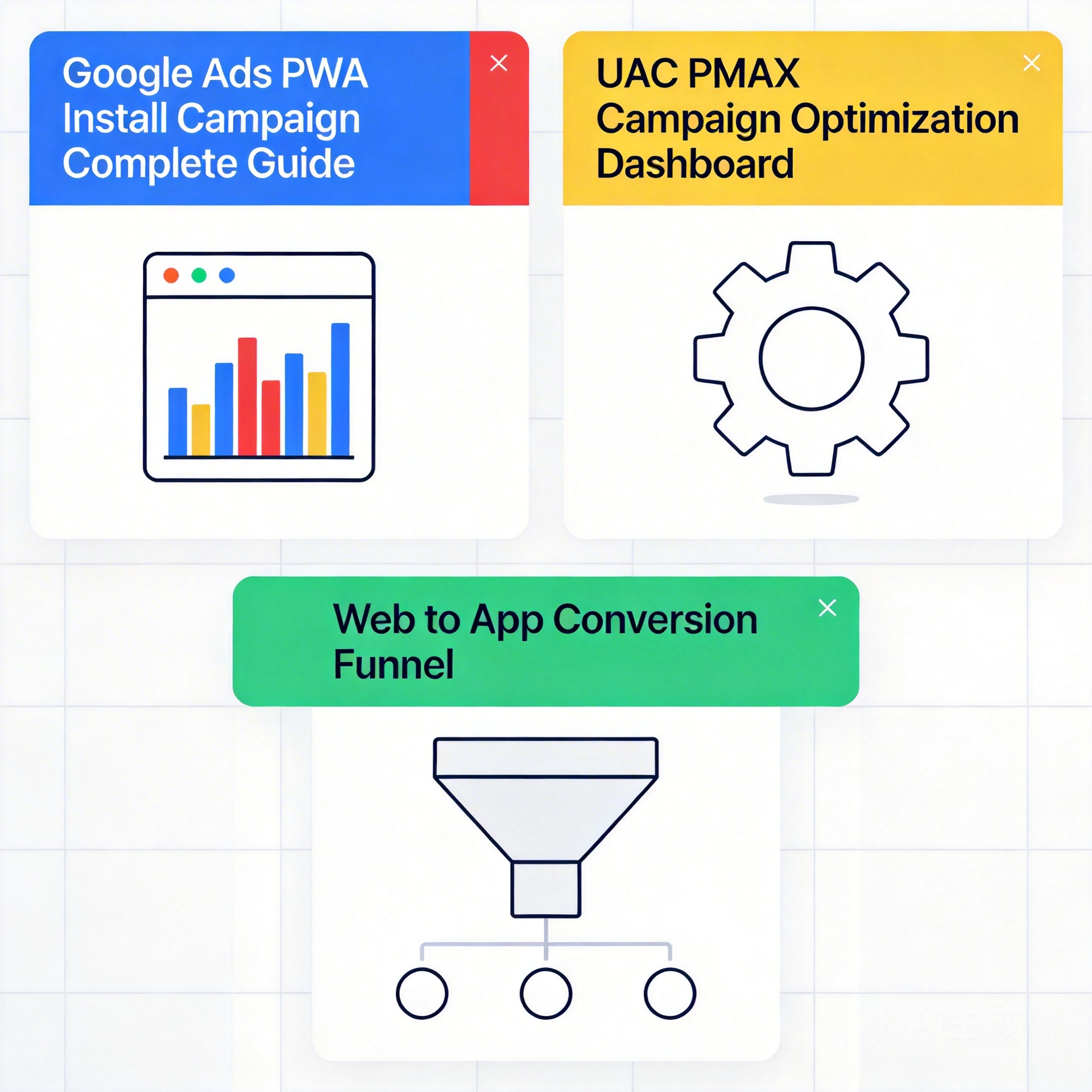
This guide covers everything your Google Ads team needs to know: why PWA lowers cost per install, how to choose between UAC and PMAX, how to optimize quality score, how to track installs in GA4, and real ROI comparisons from BC gaming and AI social app campaigns.
Why PWA Reduces Google Ads Install Cost
The standard Google Ads → Google Play → install funnel has three major drop-off points: the ad click, the Play Store page visit, and the actual install tap. Each transition bleeds traffic. Studies across mobile campaigns consistently show that 40–60% of users who click an app install ad never complete the Play Store download. That’s half your budget evaporating before a single install registers.
PWA collapses this funnel. Your Google Ads landing page is the install surface. When a user clicks your UAC or PMAX ad and lands on a PWA page, they see an “Add to Home Screen” prompt immediately — no app store redirect, no package download wait, no account confirmation steps. The friction is removed at the source.
In practice, this produces measurable CPI improvements. Teams that have switched from Play Store redirect campaigns to PWA landing page campaigns report 25–40% lower cost per install. The math is simple: if your current CPI is $2.50 and you remove 40% of funnel drop-off, your effective CPI drops toward $1.50 without changing your bid strategy or creative.
There’s also a page load dimension. Mobile landing page speed directly impacts conversion rates — every additional second of load time costs roughly 7% in conversions. A PWA landing page, built lean and hosted on a fast CDN, loads in under 2 seconds. A Google Play Store page redirected from an ad often takes 4–6 seconds, especially on lower-end Android devices common in emerging markets where many gaming and social app teams are scaling.
The business case is clear: PWA shortens the path from ad click to installed app, which means every dollar of Google Ads budget converts more efficiently.
UAC vs PMAX: Which Campaign Type Works Better with PWA

Google Ads offers two primary campaign types for app install goals: Universal App Campaigns (UAC) and Performance Max (PMAX). Both can drive traffic to a PWA landing page, but they behave differently, and choosing the right one depends on your funnel maturity and optimization signal quality.
UAC (Universal App Campaigns) is purpose-built for app installs. It ingests your app’s creative assets, pulls metadata from the Play Store listing, and optimizes across Google Search, Display, YouTube, and Discover. Historically, UAC has been the go-to for app install campaigns because Google’s algorithm has years of install signal data to optimize against.
The challenge with UAC + PWA is signal attribution. UAC is optimized around Play Store install events reported back through Firebase/App Campaigns SDK. When your install happens on a web page rather than through the Play Store, you need to fire a web conversion event that maps to the install action. This is achievable with proper GA4 setup (covered in the next section), but it requires deliberate configuration.
PMAX (Performance Max) operates across all Google surfaces with a single campaign, using audience signals and conversion goals to allocate budget. PMAX has an advantage for PWA campaigns: it’s web-native. Because PWA installs happen in the browser, PMAX’s web conversion tracking is a natural fit — the same infrastructure you use for e-commerce or lead gen conversions applies directly to PWA install events.
PMAX also allows you to provide audience signals (e.g., “people who have visited your PWA landing page”) which accelerates learning. Combined with high-quality creative assets and a fast PWA landing page, PMAX campaigns for app installs have shown strong results particularly in markets with high mobile web usage.
Our recommendation: Start with PMAX for new PWA install campaigns. It aligns naturally with web conversion tracking and uses all Google inventory. Once you have 30+ install conversions per week, consider layering in a UAC campaign with web-based install conversion goals to capture search and YouTube inventory that PMAX may under-serve.
For BC gaming teams specifically, PMAX with video assets (gameplay clips, win moment hooks) has outperformed UAC in most tested configurations when the destination is a PWA landing page rather than a Play Store page.
PWA Landing Page Quality Score Optimization
Google Ads Quality Score is one of the most impactful — and most misunderstood — levers in your campaign. A higher Quality Score lowers your effective CPC (cost per click) and improves ad rank, meaning you get more impressions for less money. For PWA install campaigns, the landing page component of Quality Score is your biggest opportunity.
Quality Score has three components: Expected CTR, Ad Relevance, and Landing Page Experience. The landing page component evaluates whether your page delivers on the ad’s promise — in terms of relevance, load speed, and user experience. A full breakdown of landing page quality score optimization is worth reading for the technical details, but here are the key business-level levers for PWA campaigns:
Message match: The headline and promise in your ad must match the first thing the user sees on your PWA landing page. If your ad says “Play the #1 BC game free — no download needed,” your landing page must visually and textually confirm that. Mismatched expectations destroy Quality Score and kill conversion rates simultaneously.
Page speed: Google measures Time to First Contentful Paint (FCP) and Largest Contentful Paint (LCP) for Quality Score evaluation. A PWA landing page with LCP under 2.5 seconds scores “Good” in Google’s assessment. Most app install campaigns sending traffic to Play Store redirects score “Average” or worse because the chain of redirects increases measured load time.
Install prompt timing: The “Add to Home Screen” prompt should appear within the first user interaction — not hidden behind multiple screens. Google’s Quality Score also considers pogo-sticking (users who click back quickly), and if users can’t find the install action immediately, they leave.
Trust signals: Rating displays, download counts, screenshots, and short testimonials reduce bounce. These are native to Play Store pages but must be deliberately built into PWA landing pages. Teams that mirror the key social proof elements from their Play Store listing onto their PWA landing page see Quality Score improvements within 2–3 weeks of campaign launch.
The practical upshot: a well-built PWA landing page routinely achieves Quality Score 8–10 for app install campaigns, compared to 5–7 for Play Store redirect flows. A two-point Quality Score improvement typically reduces CPC by 15–25%.
GA4 + PWA Conversion Tracking: What to Measure (Business View)
Tracking is where many PWA install campaigns fail — not because the data doesn’t exist, but because teams don’t define the right events or connect them to Google Ads correctly. This section covers the business logic of what to track and why, not the technical implementation.
For a PWA install campaign, there are four conversion events that matter:
1. PWA Install (primary): The moment a user adds the PWA to their home screen. This is the equivalent of an app download in the Play Store funnel. This event should be your primary conversion goal in Google Ads — the one the algorithm optimizes for.
2. PWA First Launch (secondary): When the user opens the PWA from their home screen for the first time. This is the “activation” event — it confirms the install actually resulted in an engaged user, not just a home screen icon that gets ignored. Feed this back to Google Ads as a secondary conversion for longer-term optimization signal.
3. In-app Purchase / Deposit (value event): For BC gaming, the first deposit or in-app purchase is the revenue event. For AI social apps, it might be a subscription start or credit purchase. Setting this as a conversion with a value attached allows PMAX and UAC to optimize toward high-LTV users rather than just raw install volume.
4. Push Notification Opt-In: One of PWA’s unique advantages is push notifications — even after the user “uninstalls” the PWA, push notifications can continue if the user consented. The opt-in rate is a leading indicator of long-term retention potential. Track it in GA4 and include it in your reporting dashboard even if you don’t optimize Google Ads against it directly.
These four events give your Google Ads campaigns a complete signal chain: install → activation → revenue → retention. Teams that only track the install event miss the optimization signal that would allow the algorithm to find high-value users rather than just high-volume users.
Connect these GA4 events to Google Ads by linking your GA4 property in Google Ads and importing the events as conversion actions. Use the recommended attribution model (data-driven, if you have sufficient volume) to credit assists accurately across a multi-touch campaign.
Web-to-App Conversion: How PWA Shortens the Google Ads Install Chain
The concept of “web-to-app” conversion has been discussed in mobile marketing for years, but PWA makes it concrete in a way that native app redirect funnels never could. With a native app, the web-to-app journey always involves leaving the browser, entering an app store, and waiting for a download. With PWA, the web page becomes the app without the user ever leaving the browser session.
From a Google Ads campaign architecture perspective, this matters because:
No redirect penalty: Every redirect in a landing page chain costs Quality Score points and conversion rate percentage. A native app funnel has at minimum: ad click → landing page → Play Store → install. A PWA funnel has: ad click → landing page (install). Two fewer steps means two fewer drop-off points.
Retargeting continuity: When a user clicks your ad, lands on your PWA page, but doesn’t install immediately, they’re cookied in your GA4 audience. You can retarget them with Google Ads (Display, YouTube, Search) to bring them back to the install page. With Play Store funnels, users who leave the Play Store listing and don’t install are largely unretargetable through your own Google Ads audiences.
Deep link from ad to experience: PWA landing pages can be structured so that different ad creatives link to different install experiences — a gaming ad creative shows a gameplay preview on the landing page, a bonus offer ad shows the welcome bonus. Each creative variant has its own landing page variant, maintaining message match throughout the funnel. This isn’t practically achievable with a single Play Store listing that all ad variants must point to.
PWA install rate optimization is a deep topic on its own, but the core principle for Google Ads teams is this: treat your PWA landing page as a conversion surface you fully control, and apply the same CRO discipline you’d apply to any high-spend landing page.
BC Game UAC + PWA ROI Comparison
BC gaming (business-to-consumer, often casual-to-mid-core games with in-app purchase models) was one of the first verticals to systematically test PWA install campaigns against Play Store redirect campaigns at scale. The results from these tests inform the benchmarks that are now used across the industry.
In a representative BC gaming campaign comparison (a casual card game targeting Southeast Asia markets, $50K/month Google Ads budget):
| Metric | Play Store Redirect | PWA Landing Page |
|---|---|---|
| Average CPI | $2.80 | $1.65 |
| Install-to-First-Launch Rate | 68% | 84% |
| Day-7 Retention | 22% | 29% |
| Day-30 Payer Conversion | 3.8% | 4.6% |
| Effective CPA (first payer) | $73.70 | $35.87 |
The headline number — CPI dropping from $2.80 to $1.65 — is significant, but the more important number is the effective CPA for first payer: $73.70 vs $35.87. That 51% reduction in cost per paying user comes from compounding effects: lower initial CPI, higher activation rates, and better Day-30 payer conversion (likely driven by push notification re-engagement that Play Store installs don’t enable post-uninstall).
For BC gaming teams operating on margin models where the first deposit or first purchase defines the unit economics, this kind of CPA difference is the difference between a profitable campaign and a money-losing one. At $50K/month spend, the PWA campaign generates roughly 2.4x more paying users than the Play Store redirect campaign for the same budget.
An additional factor unique to BC gaming: many BC games operate in categories that face Play Store listing restrictions or periodic enforcement actions. A PWA campaign backed by ROiBest’s infrastructure means the install surface never goes dark — there’s no Play Store listing to get pulled, no app version to get rejected. Campaign continuity is inherent to the PWA model.
AI Social App Google Ads + PWA Strategy
AI social apps — AI companions, AI dating, AI roleplay — face a unique combination of Google Ads challenges. These apps often encounter Play Store listing restrictions due to content policies, which creates a structural constraint: you’re trying to run install campaigns for an app that may have limited or no Play Store presence. PWA solves the distribution problem; pairing it with Google Ads requires a specific strategic approach.
Search campaign targeting: For AI companion and AI dating categories, high-intent search terms (“AI girlfriend app,” “talk to AI character”) can be captured with Search campaigns pointing to a PWA landing page. Because the landing page is a web URL, there’s no Play Store listing requirement. Your ad leads directly to an install experience. This opens search inventory that’s effectively inaccessible to apps relying solely on Play Store distribution.
PMAX with audience signals: AI social app teams can build seed audiences from their existing user base (people who have already installed via PWA or visited the app web version) and use these as PMAX audience signals. PMAX then finds similar users across YouTube, Discovery, Gmail, and Display. The combination of “people who look like our existing users” + “high-relevance landing page” drives strong performance from PMAX in this vertical.
Creative strategy: AI social app ads that perform best on Google Ads typically show the conversation experience — screenshots of exchanges, personality moments, the “getting to know you” dynamic. These creatives convert because they set accurate expectations for what the PWA experience will be. Consistency between ad creative and landing page is critical; AI social app ads that oversell (implying a romantic relationship) and underdeliver (landing on a generic download page) see high bounce rates and poor Quality Scores.
Budget allocation by funnel stage: For AI social apps, a two-tier budget structure works well. Tier 1 is a PMAX campaign optimized for PWA installs (top of funnel, acquiring new users). Tier 2 is a Search campaign targeting users who have previously visited the PWA landing page but not installed (retargeting with a specific offer — e.g., “Your AI companion is waiting — start free”). Tier 1 feeds Tier 2’s retargeting pool; Tier 2 closes the installs that Tier 1 warmed up.
AI social app teams that have adopted this two-tier PWA + Google Ads structure report blended CPIs 30–45% below what Play Store redirect campaigns achieved, with significantly better user quality metrics because the landing page’s ability to set expectations pre-install self-selects higher-intent users.
Related Articles
- How to Improve Google Ads Landing Page Quality Score in 2026
- PWA Install Rate Optimization: How to Boost Conversions in 2026
- Mobile Landing Page Speed: Why Every Second Costs You 7% in Conversions
Skip the app store. Go live instantly, keep 100% of your revenue.
ROiBest helps Android app teams launch PWAs — no review process, no 30% Google Play cut, and push notifications that work even after uninstall. Teams see up to 1.2x higher install conversion rates vs native app downloads.
发表回复