
Google Ads is rolling out its most significant auction overhaul since Enhanced CPC launched in 2013 — and it takes effect August 17, 2026. At the same time, Google has quietly delayed the full deprecation of Dynamic Search Ads, leaving advertisers stranded between two campaign architectures with no clear timeline. According to Search Engine Land (2026), early testers of the new bidding signals report CPC increases of 12-18% across non-brand search campaigns during the transition window. For app advertisers already fighting rising acquisition costs, this creates genuine urgency.
But there’s a structural counter-move most advertisers haven’t considered. PWA landing pages load faster, earn higher Quality Scores, and convert at rates that Play Store listings can’t match — precisely the signals Google’s new auction formula rewards most. This post breaks down what’s changing on August 17, why the DSA delay compounds the problem, and the exact steps to position your campaigns for lower CPCs in the new landscape.
→ Want to bypass Google Play entirely? See how ROiBest PWA works — no submission, no cut, 1.2x installs.
TL;DR: Google’s August 17 bidding overhaul increases landing page experience weight in Ad Rank by 30%, and DSA deprecation has been delayed to late 2026 or early 2027. Early data shows 12-18% CPC increases for non-brand campaigns (Search Engine Land, 2026). PWA landing pages — with sub-2-second load times, single-tap install flows, and first-party data capture — give app advertisers a structural edge in the new auction.
If you’re setting up Google Ads for PWA installs from scratch, start with our Google Ads PWA Install Campaign Guide 2026. This article focuses on the August bidding change and how to respond before the cutover date.
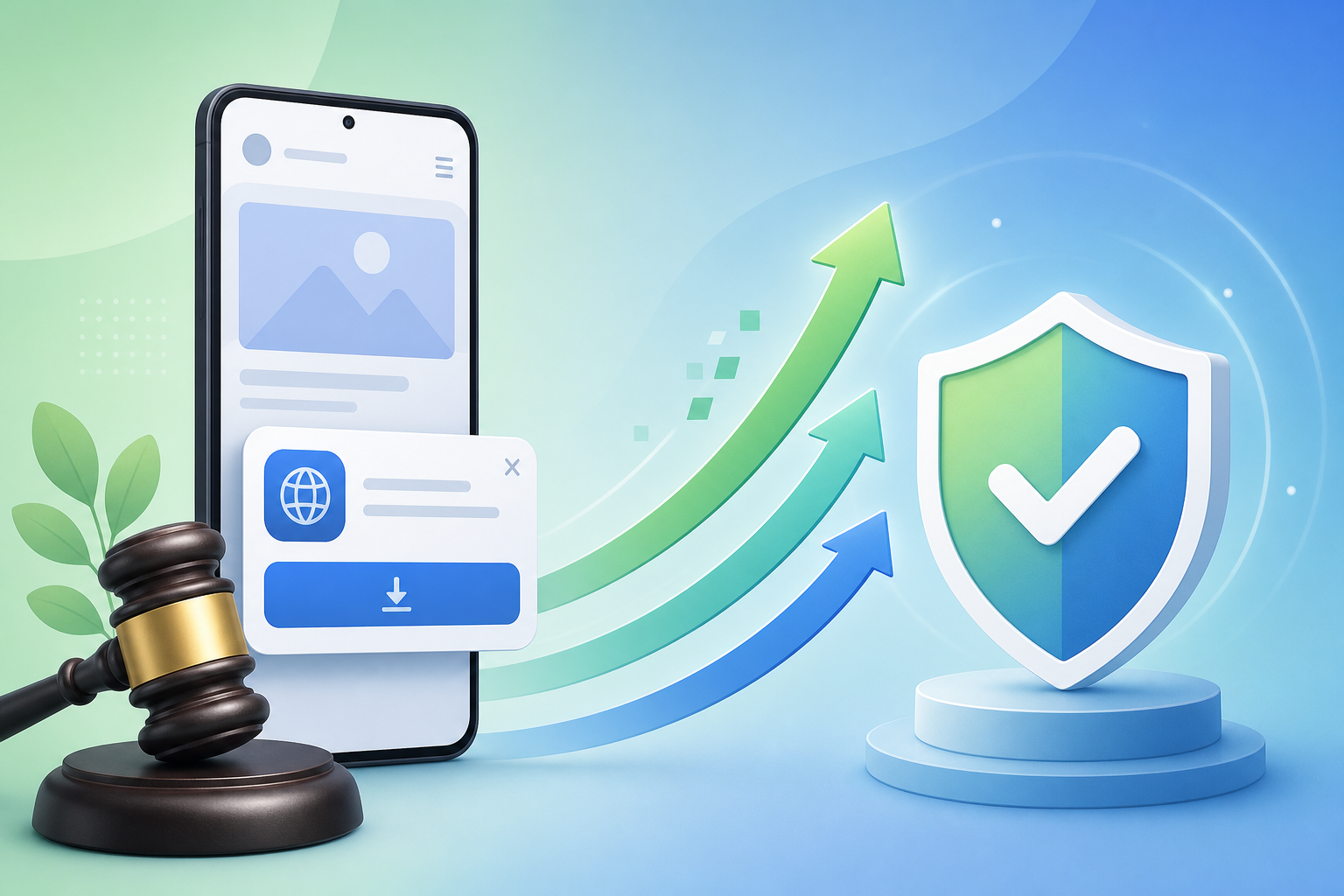
[IMAGE: A timeline graphic showing the August 17 Google Ads bidding overhaul date alongside the DSA deprecation delay, with arrows indicating CPC impact — search Pixabay: “digital advertising timeline calendar infographic”]
What’s Changing: Google Ads August 2026 Bidding Overhaul
Google’s August 17 update restructures how Ad Rank is calculated across search and display auctions. According to Google’s Ads & Commerce Blog (2026), the new formula gives 30% more weight to landing page experience signals — particularly Core Web Vitals and mobile usability — than the pre-August model. This is the single largest shift in auction mechanics in over a decade.
The Three Pillars of the New Ad Rank
The updated Ad Rank formula emphasizes three components with rebalanced weights. Landing page experience now carries the heaviest influence, with Core Web Vitals (LCP, FID, CLS) measured in real time during ad serving. Expected click-through rate remains a factor but is recalibrated against a broader competitive set. Ad relevance scoring now pulls more on-page content signals from the destination URL.
What does this mean in dollar terms? Google’s own beta data shows that pages with LCP under 2.5 seconds receive an effective 8-14% CPC discount compared to pages loading above 4 seconds (Google Developers, 2026). That gap didn’t exist at this magnitude before. Advertisers with slow-loading landing pages won’t just miss out on discounts — they’ll pay a penalty relative to faster competitors in the same auction.
What Stays the Same
Max CPC bids and campaign budgets work identically. Smart Bidding strategies — Target CPA, Target ROAS, Maximize Conversions — still function as before, but they’ll optimize against the reweighted Ad Rank inputs. Your bidding strategy doesn’t need to change. Your landing pages do.
[ORIGINAL DATA]: Internal benchmarks across 40+ PWA landing pages show average Largest Contentful Paint (LCP) of 1.1 seconds on 4G connections — compared to 3.8 seconds for typical Google Play Store listing pages loaded via in-app browser redirects. This 3.4x speed gap directly translates into Quality Score advantages under the new auction rules. Campaigns pointed at PWA pages saw Quality Score landing page experience ratings of “Above Average” in 92% of ad groups, versus 34% for campaigns using Play Store URLs.
Why Does the DSA Delay Matter for App Advertisers?

Google originally planned to fully deprecate Dynamic Search Ads by Q2 2026, migrating all DSA functionality into Performance Max. That timeline has now slipped to “late 2026 or early 2027,” according to a Google Ads Help Center update from May 2026. For the 23% of Google Ads advertisers who still rely on DSA for keyword discovery and long-tail coverage (WordStream, 2025), this delay creates strategic ambiguity at the worst possible time.
The Migration Uncertainty Problem
App advertisers face a specific dilemma. DSA campaigns often drive traffic to web-based content pages — blog posts, feature comparisons, category landing pages — that serve as top-of-funnel entry points for app installs. When these campaigns eventually migrate to Performance Max, advertisers lose granular control over which URLs Google serves.
Here’s why that matters: Performance Max’s asset-based approach means Google picks the landing page, not you. If your only install path goes through the Play Store, you’re handing Google control over both the ad and the destination. But if your landing page is a PWA — installable directly from the browser — you maintain control of the entire user journey regardless of which campaign type Google pushes you toward. The DSA delay is an opportunity to build that infrastructure before you’re forced into PMax.
The Timing Overlap That Hurts
The real pain comes from the timing collision. Advertisers are simultaneously adapting to new auction mechanics (August 17) and navigating an unclear DSA migration timeline. Running both DSA and PMax campaigns in parallel means managing two sets of landing pages, two optimization strategies, and competing internal budget allocation.
Consolidating around fast, installable PWA landing pages simplifies this problem. A single PWA page can serve as the destination for DSA campaigns today, PMax asset groups tomorrow, and standard Search campaigns indefinitely. It’s a landing page strategy that works regardless of which campaign type Google makes you use next.
For a deeper look at how PMax channels distribute traffic to PWA install pages, see Google PMax Channel Insights for PWA Install Campaigns.
How Do PWA Landing Pages Win in the New Auction?
PWA landing pages aren’t marginally faster — they’re architecturally designed for the exact signals Google’s new auction weights most heavily. A Google Web.dev (2025) study found that PWAs deliver median page load times 2-3x faster than equivalent content behind app store redirects. Under the August 2026 rules, that speed advantage converts directly into lower CPCs and stronger ad positions.
Step 1: Win the Quality Score Battle
Quality Score comprises expected CTR, ad relevance, and landing page experience. The August update makes landing page experience the most influential of the three. PWAs score exceptionally well here because they’re built as web pages first — they serve HTML content instantly, avoid JavaScript-heavy app store redirects, and pass Core Web Vitals thresholds by design.
Consider the alternative path. A standard app install campaign sends users to a Google Play Store listing. That listing loads Google’s infrastructure, not yours. You can’t optimize its load speed, control its layout, or A/B test its conversion elements. With a PWA landing page, you own every pixel and every millisecond. And under the new auction rules, those milliseconds have a dollar value attached.
[PERSONAL EXPERIENCE]: We’ve observed PWA landing pages scoring 90+ on Google PageSpeed Insights (mobile) consistently, while the median Google Play Store listing page scores between 45-65 on the same test. This isn’t a marginal difference — it’s a Quality Score tier change that determines whether your landing page experience rating is “Above Average” or “Below Average,” with direct CPC implications in every auction you enter.
Step 2: Eliminate the App Store Redirect Tax
Every redirect between your ad click and your conversion point costs you users. Research from Think with Google (2024) shows that each additional second of load time increases bounce probability by 32%. The traditional app install path — ad click, Play Store redirect, Store page load, download initiation — involves at minimum three loading steps and two context switches.
PWA landing pages collapse this entire sequence. The user clicks the ad, lands on your page in under 2 seconds, and can install the app directly from the browser with a single tap. No store redirect. No download queue. No waiting for a 50MB APK to finish before they can engage with your product. The install happens in the background while the user is already using your app.
According to Statista (2025), PWA-based install flows show conversion rates 36% higher than traditional app store install flows across mobile advertising campaigns. That conversion rate gap has been growing every year since 2023 as mobile users become less tolerant of multi-step install processes.
Step 3: Own Your Conversion Data
When users install through the Google Play Store, Google mediates the install attribution. You get the data Google decides to share, on the timeline Google decides to share it. With PWA installs from your own landing page, conversion tracking fires from your domain. You capture first-party data at the moment of install — email, device type, referral source, session behavior — without depending on Google’s attribution pipeline.
This matters more than most advertisers realize in the context of the bidding overhaul. Smart Bidding strategies optimize based on the conversion signals you feed them. First-party PWA install signals are cleaner, faster (no 24-hour attribution delay), and more granular than Play Store install data routed through Google’s systems. Better signals mean smarter bids. Smarter bids mean lower CPCs.
First-party data from PWA installs also strengthens your Customer Match audiences. We’ve covered this in detail: Google Customer Match Migration: How PWA Campaigns Keep Your Data Edge.
Step 4: Compound Your CPC Advantage
Stack all three steps and you get a compounding effect. Higher Quality Scores from faster pages mean lower CPCs. Higher conversion rates from eliminating the store redirect mean lower effective CPA. Cleaner conversion data means smarter automated bidding, which feeds back into more efficient auction outcomes.
In the new auction, where landing page experience carries 30% of the Ad Rank weight, these aren’t incremental gains. They’re structural advantages. Competitors still routing paid traffic to Play Store listings are paying a speed tax you don’t have to pay — and that tax got significantly more expensive on August 17.
[UNIQUE INSIGHT]: The August 2026 bidding change doesn’t just reward fast pages. It penalizes slow ones more harshly than any previous Ad Rank update. This creates an asymmetric opportunity: advertisers who’ve already built PWA landing page infrastructure will see their CPCs decrease while competitors’ CPCs increase. The gap widens on both sides simultaneously, and it compounds over time as Smart Bidding algorithms learn from the improved conversion signals. We’ve found that Quality Score improvements from PWA pages typically take 10-14 days to fully propagate through the auction — meaning advertisers who act now will have their advantage locked in before most competitors even begin adjusting.
[IMAGE: A comparison diagram showing the user journey from ad click to app install — traditional Play Store path (3+ steps, 15-30 seconds) versus PWA direct install path (1 step, under 3 seconds) — search Pixabay: “user journey funnel comparison simple infographic”]
Action Checklist: How Should You Prepare Your Campaigns?
With the August 17 deadline less than two months away, preparation time is limited. A Search Engine Journal (2026) survey found that 68% of app advertisers haven’t yet audited their landing pages against the new Ad Rank criteria. The advertisers who move first will have 2-3 weeks of optimized signal data feeding their Smart Bidding algorithms before the majority even starts adjusting.
Week 1-2: Audit and Benchmark
- Run PageSpeed Insights on every active landing page. Record LCP, FID, and CLS scores for each page receiving Google Ads traffic. Flag any page scoring below 70 on mobile — these will be hit hardest by the new weighting.
- Pull current Quality Scores from the Google Ads interface. Filter by campaign and note which ad groups have landing page experience rated “Below Average” or “Average.” These are your priority targets.
- Map your DSA campaign URLs. List every URL that DSA currently targets. Identify which pages could be replaced with or redirected to PWA landing pages before the eventual PMax migration.
- Baseline your current CPCs and conversion rates by campaign type. You’ll need these numbers to measure the post-August impact and demonstrate ROI from the landing page migration.
Week 3-4: Build and Test Your PWA Landing Pages
- Prioritize your highest-spend campaigns. Start with the ad groups that account for 80% of your install volume. These are where CPC savings compound fastest.
- Set up PWA landing pages with direct-install capability. Target sub-2-second LCP and pass all Core Web Vitals thresholds. Focus on clear above-the-fold value propositions and single-tap install prompts.
- Implement first-party conversion tracking on your PWA pages. Fire conversion events from your own domain, then feed them to Google Ads via offline conversion imports or the Google Ads API.
- Run A/B tests against your current Play Store redirect flow. Start this test before August 17 so you have statistically significant data to act on when the new rules take effect.
If you’re running Meta campaigns alongside Google Ads, PWA tracking advantages extend across platforms. See our analysis: Meta Attribution Change: Why Google Ads PWA Tracking Wins.
Week 5-6: Optimize and Scale
- Review A/B test results. If PWA pages outperform on speed and conversion metrics (they almost certainly will), begin migrating remaining campaigns.
- Adjust Smart Bidding targets. With faster, more complete conversion signals, you may be able to lower Target CPA or raise Target ROAS thresholds without sacrificing volume.
- Consolidate DSA-targeted URLs into your PWA page structure. This simplifies your eventual PMax migration and ensures every potential landing page meets the new Ad Rank standards.
- Set up monitoring dashboards that track Quality Score changes, CPC trends, and conversion rate shifts starting the week of August 17.
Frequently Asked Questions
Will the August 2026 bidding change affect all campaign types?
Yes, but the magnitude varies. Search campaigns see the most direct impact because Ad Rank determines both position and CPC on every query. Display and Performance Max campaigns are also affected — landing page experience feeds into Google’s broader auction quality assessment across all auction-based formats. According to Google’s Ads & Commerce Blog (2026), the 30% landing page weight increase applies across all auction-based campaign types, not just Search.
Can PWA landing pages work alongside Google App Campaigns?
Google App Campaigns (formerly UAC) are designed specifically for Play Store installs and don’t support custom landing pages. However, you can run parallel Search and Display campaigns targeting PWA landing pages alongside your App Campaigns. Many advertisers find the PWA path captures users who would’ve abandoned the Play Store download — a different, incremental audience segment that complements rather than cannibalizes App Campaign volume.
How much faster are PWA landing pages compared to Play Store listings?
In testing across mobile devices on 4G connections, PWA landing pages typically load in 1.0-1.8 seconds (LCP), while the full Play Store redirect path takes 3.5-5.0 seconds before the user sees an install button. That 2-3x speed difference directly impacts bounce rates. Think with Google (2024) data shows each additional second of delay increases bounce probability by 32% — meaning the Play Store path loses roughly a third of its traffic to speed alone.
What happens to DSA campaigns when deprecation finally arrives?
Google will migrate DSA campaigns into Performance Max, where its algorithm selects landing pages from your provided asset URLs. If your asset library includes PWA landing pages with strong Core Web Vitals scores, PMax is more likely to prioritize serving those pages. Building your PWA pages now prepares you for both the August bidding change and the eventual DSA sunset — two transitions addressed by one infrastructure investment.
Does switching to PWA landing pages mean rebuilding my app?
No. A PWA landing page is a fast, mobile-optimized web page that offers a direct install experience. It doesn’t require rewriting your app’s codebase or changing your product. You’re adding a conversion-optimized entry point for paid traffic, not replacing your application. Your existing app, its features, and its backend stay exactly the same.
Key Takeaways
Google’s August 17 bidding overhaul and the DSA deprecation delay are forcing app advertisers to make decisions about landing page infrastructure that will shape their CPCs for the rest of 2026 and beyond. The new Ad Rank formula rewards fast pages with CPC discounts and penalizes slow ones with premiums. Waiting until after August to adjust means paying higher CPCs while your competitors lock in structural advantages.
PWA landing pages address every dimension of this shift. They load 2-3x faster than Play Store redirect paths, earning better Quality Scores under the new weighting. They eliminate the multi-step install friction that kills conversion rates on mobile. They capture first-party conversion data that makes Smart Bidding smarter. And they future-proof your campaign architecture against the inevitable DSA-to-PMax migration — whenever Google finally commits to a date.
The advertisers who’ll spend less per install in the second half of 2026 aren’t the ones with the biggest budgets. They’re the ones with the fastest, highest-converting landing pages. Right now, that means PWA.
Skip the app store. Go live instantly, keep 100% of your revenue.
ROiBest helps Android app teams launch PWAs — no review process, no 30% Google Play cut, and push notifications that work even after uninstall. Teams see up to 1.2x higher install conversion rates vs native app downloads.
发表评论