

Measurement Is Now the #1 Priority in Advertising — And Your Install Attribution Is Broken
At every major 2026 Upfronts presentation, the same theme dominated the conversation: measurement. Not reach. Not creative. Not inventory. Measurement. Buyers at every level — CTV, programmatic, performance — are demanding proof that their dollars are actually driving outcomes. For Google Ads teams running app install campaigns, this shift lands with particular force.
If you’re running UAC or PMax campaigns to drive Android app installs, you already know the attribution headaches: SDK misfires, Play Store attribution gaps, delayed conversion signals, cross-device gaps that inflate CPA and deflate ROAS. The industry’s new obsession with measurement precision arrives just as your tracking stack is under the most pressure it has ever been.
The good news: there’s a cleaner path. PWA-based distribution — particularly for Android — sidesteps most of these attribution problems by design. And in a world where measurement is now boardroom-level concern, that cleanliness translates directly into competitive advantage for performance buyers.
→ Want to bypass Google Play entirely? See how ROiBest PWA works — no submission, no cut, 1.2x installs.
The Measurement Crisis: Why 2026 Changed Everything

The 2026 Upfronts marked a genuine inflection point. For years, CTV buyers complained about walled gardens and unmeasurable inventory. But 2026 was the year measurement accountability crossed from CTV into performance advertising at scale. Several forces converged:
- Advertiser pressure on proof of performance: Major brands publicly shifted budget away from channels that couldn’t demonstrate clean, third-party-validated attribution. The ripple effect hit performance budgets — including Google Ads app campaigns.
- Privacy regulation tightening: ATT, GDPR enforcement actions in 2025, and expanding state-level privacy laws in the US continued eroding the reliability of device-level tracking. Mobile measurement partners (MMPs) began warning clients that attribution match rates were declining industry-wide.
- Google’s own signals shift: Enhanced conversions and consent mode v2 became mandatory, adding complexity to the measurement stack for any team running native app campaigns through Google Ads.
- CFO scrutiny: In an environment of tighter growth budgets, finance teams are demanding that marketing prove unit economics — cost per install, cost per quality install, lifetime value by acquisition channel. Fuzzy attribution doesn’t survive that scrutiny.
The result: Google Ads app campaign teams are caught between rising measurement demands from leadership and a fragmented attribution infrastructure that was never designed for this level of precision. Native app installs routed through Google Play carry an inherent measurement tax — one that PWA distribution avoids entirely.
How PWA Distribution Solves the Attribution Problem
The measurement advantage of PWA distribution is not a side benefit. It is a core structural advantage for any team serious about performance accountability.
Here is how the measurement difference plays out in practice:
1. Install Events Are Web Events — Tracked Directly in GA4
When a user installs a PWA on Android, the install trigger is a web event: the browser’s beforeinstallprompt fires, the user accepts, and the install completes. This event can be captured directly by GA4 and pushed to Google Ads as a conversion — without any SDK, without any MMP, without any app store intermediary.
For your Google Ads team, this means the install conversion signal travels the shortest possible path from user action to your campaign dashboard. No Play Store attribution window. No SDK initialization delay. No cross-app attribution hop. The signal is clean, fast, and owned by your measurement stack.
2. No App Store Attribution Gap
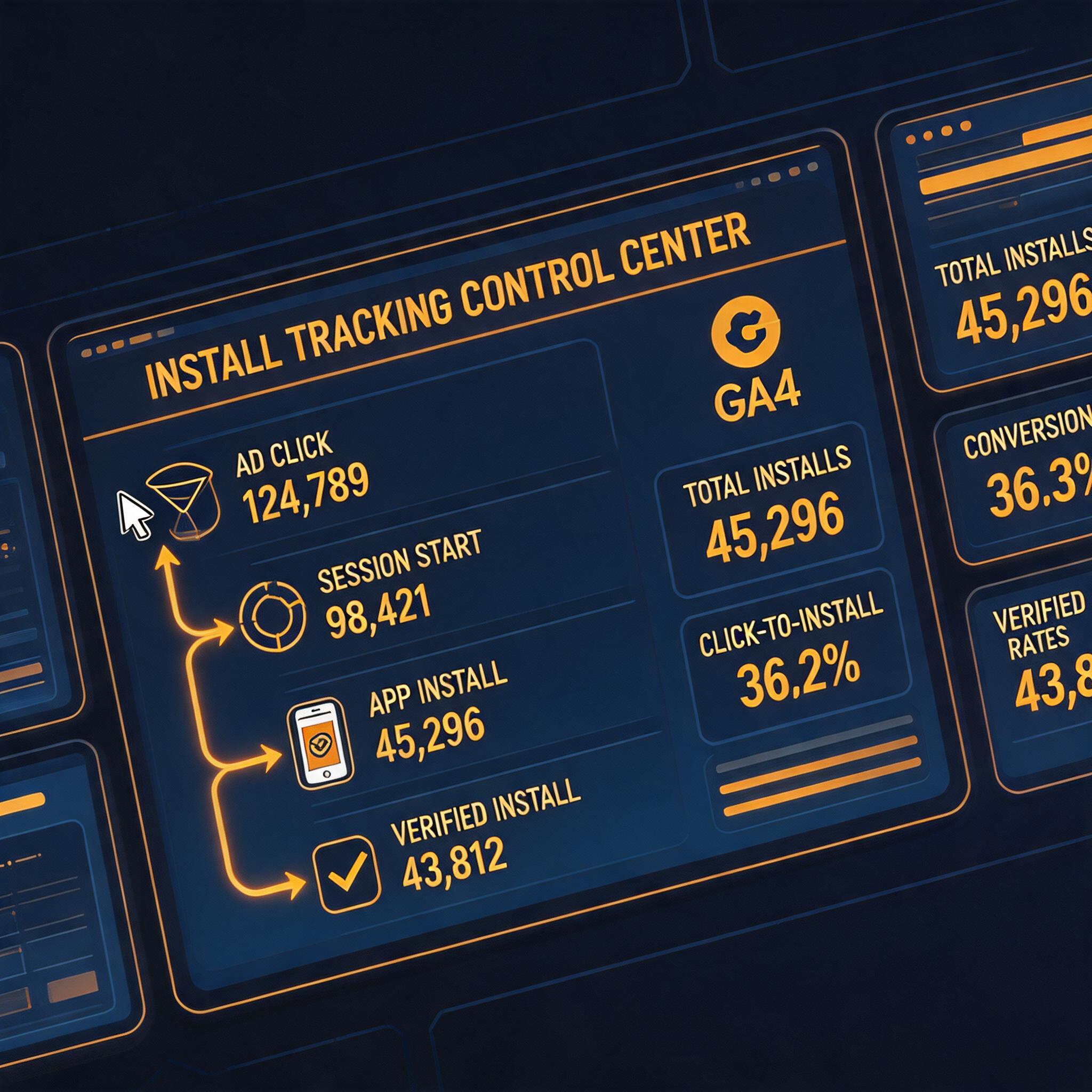
Native app campaigns via Google Ads route users through the Play Store. The attribution chain is: Ad click → Play Store listing → Download → App open → SDK fires conversion. Every handoff in that chain is a potential measurement failure point. Play Store redirect tracking has known discrepancy rates. SDK fires can be delayed or missed entirely on low-end Android devices (a major segment in Southeast Asia, Latin America, and South Asia — key growth markets).
PWA removes the Play Store from the chain entirely. The attribution path becomes: Ad click → Web landing page → PWA install event → GA4 conversion → Google Ads reported. Fewer handoffs, fewer failure points, higher attribution fidelity.
3. GTM Gives You Full Measurement Control
Because PWA installs are web events, Google Tag Manager manages your entire measurement stack. GTM triggers, custom events, and consent mode integration work exactly as they do for any web campaign. Your team doesn’t need to coordinate with a mobile dev team to instrument new conversion events. Changes to your measurement setup deploy in minutes, not weeks. For teams under pressure to improve attribution quality, this operational speed is itself a competitive advantage.
4. Post-Install Engagement Signals — Including Push
One of the persistent measurement gaps in native app campaigns is what happens after install. Push notification engagement, re-engagement events, and re-install after uninstall are all difficult to attribute cleanly back to the originating campaign.
PWA push notifications work even after the user “uninstalls” (removes from home screen). Re-engagement events triggered by push can be tracked as web events in GA4, tied back to the original acquisition campaign via standard UTM parameters. This gives Google Ads teams a continuous attribution thread from initial ad impression through long-term user engagement — something native app campaigns struggle to provide cleanly.
The Attribution Gap in Numbers
Industry data from MMP providers in 2025 showed that native Android app install attribution has an average discrepancy rate of 12–18% between reported installs and actual installs, depending on the market. In Southeast Asian markets — high-volume, low-end device environments — discrepancy rates reach 20–25%.
For a Google Ads team spending $500,000/month on UAC, a 15% attribution discrepancy means $75,000/month of spend with no reportable outcome. In a 2026 measurement-first environment, that gap is not sustainable.
Teams using PWA distribution report a different picture. Because web-event install tracking via GA4 eliminates the Play Store attribution gap and SDK initialization delays, reported install rates align more closely with actual installs. ROiBest clients have seen measured install conversion rates run 1.2x higher than comparable native app campaigns on the same Google Ads budget — not because more installs are happening, but because more installs are being captured in the measurement stack.
That 1.2x factor has an outsized impact on campaign optimization. Google Ads’ Smart Bidding algorithms optimize toward reported conversions. When your measurement is capturing more of the actual signal, Smart Bidding finds better audiences, bids more efficiently, and compounds performance over time.
Mid-Article Checkpoint: If your UAC or PMax campaigns are showing strong reach but weak reported conversion rates, the problem may not be your creative or your audience — it may be your attribution stack. A Google Ads PWA install campaign guide can help you map the measurement difference before assuming you need to change your bid strategy.
Common Concerns About PWA Measurement Accuracy
“Won’t web-based tracking still have consent and privacy issues?”
Yes — but fewer of them, and they’re easier to manage. PWA install tracking via GA4 + consent mode v2 gives you a fully compliant measurement path. Consent mode v2 is already mandatory for Google Ads conversion tracking in the EU; if your team is compliant for web campaigns, PWA install tracking drops into the same framework. There is no additional compliance layer required beyond what you’re already running for your web properties.
By contrast, native app campaigns require SDK-level consent management, platform-specific implementations for iOS and Android, MMP-level consent mode integration, and separate consent records for push notification permissions. The compliance surface is significantly larger.
“Is PWA install tracking accepted by Google Ads as a conversion?”
Yes. PWA install events tracked as GA4 conversions and imported into Google Ads are treated as standard web conversions — the same way any landing page conversion is tracked. They are fully compatible with Smart Bidding (Target CPA, Target ROAS), PMax asset groups, and standard UAC optimization. See the PMax Android PWA cost per install analysis for benchmark data on how these campaigns perform at scale.
“What about attribution for users who install on a different device than they clicked the ad?”
Cross-device attribution is a challenge for all digital advertising, not specific to PWA. However, Google Ads’ cross-device attribution — powered by signed-in Google accounts — works the same way for web conversions as for app conversions. In practice, the cross-device problem is no worse for PWA installs than for native app installs, and the rest of the attribution chain is significantly cleaner.
“Does PWA install data integrate with our existing BI and reporting stack?”
Because PWA install events are web events in GA4, they export to BigQuery, flow into Looker Studio dashboards, and integrate with any downstream reporting tool that already handles GA4 data. There is no separate mobile analytics SDK to maintain. For teams that have invested in GA4 + BigQuery infrastructure for web reporting, PWA installs slot directly into the existing stack.
Three Steps to Shift Your Google Ads Attribution to PWA
For Google Ads teams ready to act on the 2026 measurement mandate, the migration path is straightforward. ROiBest handles the technical infrastructure — your team focuses on campaign strategy:
- Audit your current attribution gaps. Pull your UAC and PMax campaign data for the last 90 days. Compare Google Ads reported installs against Firebase/GA4 first_open events. The delta between these numbers is your current attribution gap. For most teams, this number is surprising. If reported installs in Google Ads exceed GA4 first_open events by more than 10%, your measurement stack is overreporting — and Smart Bidding is optimizing toward phantom conversions.
- Map your conversion events to web equivalents. Work with ROiBest to identify which in-app conversion events matter most for your campaign optimization (install, registration, first purchase, return visit). These events get mapped to GA4 web events that PWA can fire directly — without SDK instrumentation on your end. This step typically takes 1–2 business days.
- Run a parallel campaign test. Rather than migrating your full budget immediately, run a 30-day parallel test: your existing native app UAC campaign alongside a PWA install campaign targeting the same audience segments. Compare reported install rates, CPI, and downstream conversion rates between the two. The measurement advantage typically becomes visible within the first two weeks, as GA4 event matching rates for PWA significantly outperform SDK-based attribution for the same audience. Review Google UAC campaign optimization tips to structure the test correctly.
Summary: In a Measurement-First World, Clean Attribution Is a Performance Moat
The 2026 Upfronts signaled a permanent shift in how the advertising industry evaluates channel performance. Measurement is no longer a reporting function — it is a competitive variable. Channels that can demonstrate clean, precise, auditable attribution will capture budget. Channels that cannot will lose it.
For Google Ads teams running Android app install campaigns, PWA distribution is the clearest path to measurement-first performance. The attribution chain is shorter, the tracking infrastructure is simpler, the compliance surface is smaller, and the signal quality that reaches Smart Bidding is higher. The result is campaigns that optimize faster, spend more efficiently, and report more accurately to leadership.
ROiBest exists to make this transition operational for app teams without requiring internal engineering resources. The measurement advantage is available now — before the next budget cycle, before the next leadership review, before your competitors figure out the same thing.
Skip the app store. Go live instantly, keep 100% of your revenue.
ROiBest helps Android app teams launch PWAs — no review process, no 30% Google Play cut, and push notifications that work even after uninstall. Teams see up to 1.2x higher install conversion rates vs native app downloads.
发表回复